German Machine Tools, Russian Gunpowder and the Uzbekistan Connection
From high-precision machinery to cotton pulp used by Russian munitions plants, a growing trail of customs investigations and sanctions decisions is putting Uzbekistan under closer scrutiny as European authorities try to close the routes feeding Russia's military-industrial complex.
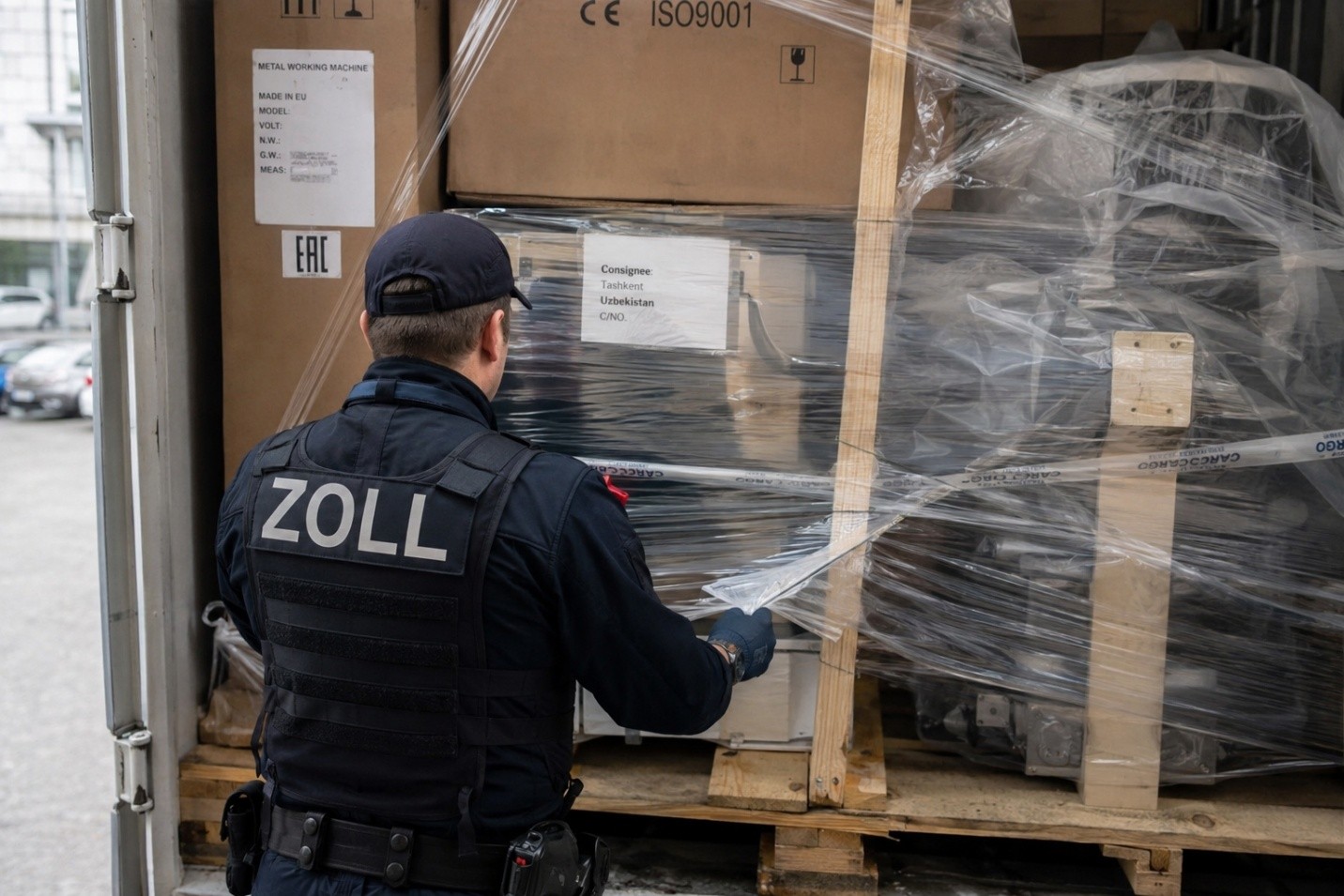
In February 2025, German customs investigators searched ten properties across Thuringia, Saxony-Anhalt, Berlin and Saxony as part of an investigation into suspected violations of EU export controls. Austrian authorities simultaneously searched properties near Graz.
At the centre of the German investigation were machine tools intended for export to Uzbekistan. One shipment had been stopped at Leipzig/Halle Airport. Investigators said one of the machines, based on its technical specifications, could potentially be used to manufacture artillery and gun barrels. German authorities also secured assets worth approximately €3.1 million.
The case was significant not simply because Uzbekistan appeared as the declared destination of sensitive industrial equipment, but because it was followed by further investigations into German machinery allegedly reaching Russia through third countries.
Five months later, more than 140 customs investigators took part in searches connected to a machine-tool manufacturer near Munich. Investigators were examining suspected exports of more than 20 high-precision machines worth approximately €5.5 million that allegedly reached Russia despite EU restrictions. Uzbekistan appeared among the third-country routes under scrutiny, alongside Turkey and China.
The investigations point to a broader problem confronting European sanctions enforcement: determining whether the declared buyer of sophisticated industrial equipment is also its genuine end user.
From Transit Route to Direct Supplier
The machine-tool investigations concern equipment suspected of being rerouted through third countries. A separate trail involving Uzbek companies is more direct.
An investigation by the Organized Crime and Corruption Reporting Project (OCCRP), together with Vlast and iStories, found that Uzbek producers had supplied cotton pulp to Russian companies, including direct shipments to plants involved in ammunition and propellant production.
Cotton pulp is a raw material used in the production of nitrocellulose, which in turn is used to manufacture gunpowder and other propellants.
According to trade records reviewed by the investigators, Uzbekistan's Fergana Chemical Plant – now officially listed by the EU as Fargona Kimyo Zavodi LLC – made direct shipments worth more than $2.2 million to gunpowder plants in Kazan and Perm during 2022 and early 2023.
Another Uzbek producer, Raw Materials Cellulose, made 14 direct shipments worth almost $500,000 to the Tambov Gunpowder Plant in 2022.
The wider trade figures are striking. According to export-import data cited by OCCRP, Uzbek companies exported approximately $8.7 million worth of cotton pulp to Russia during the first nine months of 2023 – more than 70 percent above the value recorded for the whole of 2022.
The original investigation stopped short of claiming that every shipment of Uzbek cotton pulp ended up in ammunition used in Ukraine. Reporters said they could not establish the final use of every consignment, and some suppliers maintained that their products were intended for industrial uses such as lacquers and paints.
Subsequent European sanctions decisions, however, went considerably further.
Brussels Draws a Direct Link
On 23 April 2026, the European Union added both Fargona Kimyo Zavodi LLC and Raw Materials Cellulose LLC to its Russia sanctions regime.
The EU's legal justification is unusually explicit.
According to the EU listing, Fargona Kimyo Zavodi supplies cotton pulp to the Perm Powder Plant and the Kazan State-Owned Gunpowder Plant. The EU states that those entities have used the material to manufacture weapons for the Russian Armed Forces.
The EU therefore concluded that the Uzbek company supports Russia's military-industrial complex through its involvement in the supply of military technology and equipment.
The same decision identifies Raw Materials Cellulose as a supplier of cotton pulp to Russian military-industrial companies, including the Tambov Gunpowder Plant, which uses the material to manufacture gunpowder.
The sanctions decisions transformed what had initially emerged through trade data and investigative reporting into an official European finding.
They also exposed a corporate connection.
The EU identifies Fargona Kimyo Zavodi as being controlled by Uzbek businessman Rustam Muminov. Muminov had already come under sanctions before the April 2026 measures against the companies. The United Kingdom subsequently listed Muminov, Fargona Kimyo Zavodi and Raw Materials Cellulose among actors involved in supporting Russia's military-industrial complex in its sanctions action of 18 December 2025.
The sequence matters. What began as scrutiny of commercial flows from Central Asia has progressively moved into formal sanctions enforcement.
The Nominal-Recipient Problem
Another Uzbek company illustrates a different mechanism.
On 30 October 2024, the US Treasury sanctioned Tashkent-based OOO Uzstanex as part of a procurement network designed to move advanced machine tools to Russia.
The Treasury described Uzstanex, together with Kazakhstan-based Kazstanex, as a "nominal recipient" of machine-tool shipments originating in Europe.
According to the US government, the companies received equipment that was subsequently sent to Shanghai Winsun Imp and Exp Co Ltd in China before ultimately reaching Russia.
The network was allegedly coordinated by Russian nationals and relied on Central Asian intermediaries to disguise the real destination of European industrial equipment.
That distinction is important.
Uzstanex was not accused merely of selling an ordinary commercial product that later happened to reach Russia. According to the US Treasury, its role was embedded in a procurement structure specifically designed to transship advanced machine tools to Russian end users.
Combined with the German investigations, the case highlights one of the most difficult weaknesses in Europe's export-control system: a machine can legally appear to be destined for a company thousands of kilometres from Russia while its ultimate end user may be elsewhere.
A Pattern European Exporters Can No Longer Ignore
None of these cases, taken individually, proves that Uzbekistan as a state is systematically facilitating Russian sanctions evasion.
That distinction matters.
Tashkent has maintained an officially neutral position on Russia's war against Ukraine and has sought to preserve economic relations with both Moscow and the West. The cases documented by German investigators, the US Treasury and European sanctions authorities concern specific companies, transactions and procurement networks rather than an official Uzbek government policy.
But the accumulation of cases is becoming increasingly difficult to dismiss as irrelevant to European sanctions enforcement.
Uzbekistan now appears in several distinct categories of Russia-related supply chains.
German investigators have examined sensitive machine tools declared for export to Uzbek recipients. US authorities have identified an Uzbek company as a nominal recipient in a network moving European machine tools toward Russia. Investigative journalists documented direct Uzbek cotton-pulp shipments to Russian gunpowder plants. The European Union has subsequently sanctioned two of the Uzbek suppliers and explicitly linked their products to Russia's military-industrial complex.
These are different cases, involving different companies and different enforcement authorities.
That is precisely why the pattern matters.
The question for European governments is therefore no longer simply whether individual exporters knowingly violate sanctions. It is whether existing end-user verification is capable of detecting procurement networks that use legitimate-looking companies in third countries to separate European suppliers from Russian end users.
The European Exposure
For European manufacturers, particularly producers of machine tools and other sensitive industrial equipment, the consequences are increasingly practical rather than theoretical.
A company may comply with the formal requirement not to sell restricted equipment directly to Russia and still face significant regulatory exposure if its products are subsequently diverted through intermediaries.
The Uzbekistan cases demonstrate why compliance based solely on the immediate purchaser is becoming inadequate.
Exporters dealing in sensitive machinery, electronics and dual-use goods increasingly need to understand not only who is buying their products, but who controls the buyer, whether the volume of the order is consistent with the customer's actual business, where similar equipment has previously been resold, and whether the proposed transaction makes commercial sense given the recipient's industrial capacity.
Unusual payment structures, newly established intermediaries, unexplained changes in shipping routes and customers with limited evidence of genuine industrial activity should all attract greater scrutiny.
The commercial consequences of getting those judgments wrong can be substantial: frozen assets, criminal investigations, sanctions exposure and reputational damage.
Uzbekistan's Test
For Uzbekistan, the issue presents a different challenge.
The country has spent years positioning itself as an increasingly open destination for European investment and as a bridge between Europe and Central Asia. That strategy depends partly on the credibility of its financial system, customs controls and corporate sector.
Repeated appearances of Uzbek entities in Western sanctions investigations risk complicating that effort.
The central question is therefore not whether Uzbekistan has officially joined Western sanctions against Russia – it has not – but whether its domestic enforcement mechanisms are capable of preventing companies operating on its territory from becoming intermediaries or suppliers for sanctioned Russian military-industrial networks.
The distinction between political neutrality and commercial permissiveness is becoming increasingly important.
Europe's sanctions architecture was designed primarily to restrict Russia's direct access to Western technology and industrial inputs. As those restrictions have tightened, enforcement has increasingly shifted toward the third-country networks that can provide alternative routes.
Uzbekistan is not the only country facing that scrutiny. Turkey, China, Kazakhstan, Kyrgyzstan, the United Arab Emirates and other jurisdictions have also appeared in Western investigations into diversion and sanctions circumvention.
But the combination of German machine-tool investigations, US enforcement actions and direct supplies to Russian gunpowder plants makes the Uzbek cases particularly relevant.
The evidence does not establish a state-directed Uzbek programme to support Russia's war economy.
It does establish something narrower – and for European regulators potentially more consequential: Uzbekistan has repeatedly appeared in documented supply chains connecting foreign industrial goods and raw materials with Russia's military-industrial complex.
For European exporters, banks and investors, that is enough to change the risk calculation.
Enhanced due diligence on sensitive transactions involving Uzbek counterparties should no longer be treated simply as a regulatory precaution. In sectors exposed to diversion risk, it is increasingly becoming a commercial necessity.
Marta Kozłowska