Army After the Era of “Counting Tanks”: How Kazakhstan’s Military Potential Is Changing
Drones, secure communications, electronic warfare, artificial intelligence and domestic industry now matter no less than the quantity of equipment. Against this backdrop Kazakhstan has changed its force structure, its industrial base and its very approach to modern warfare.
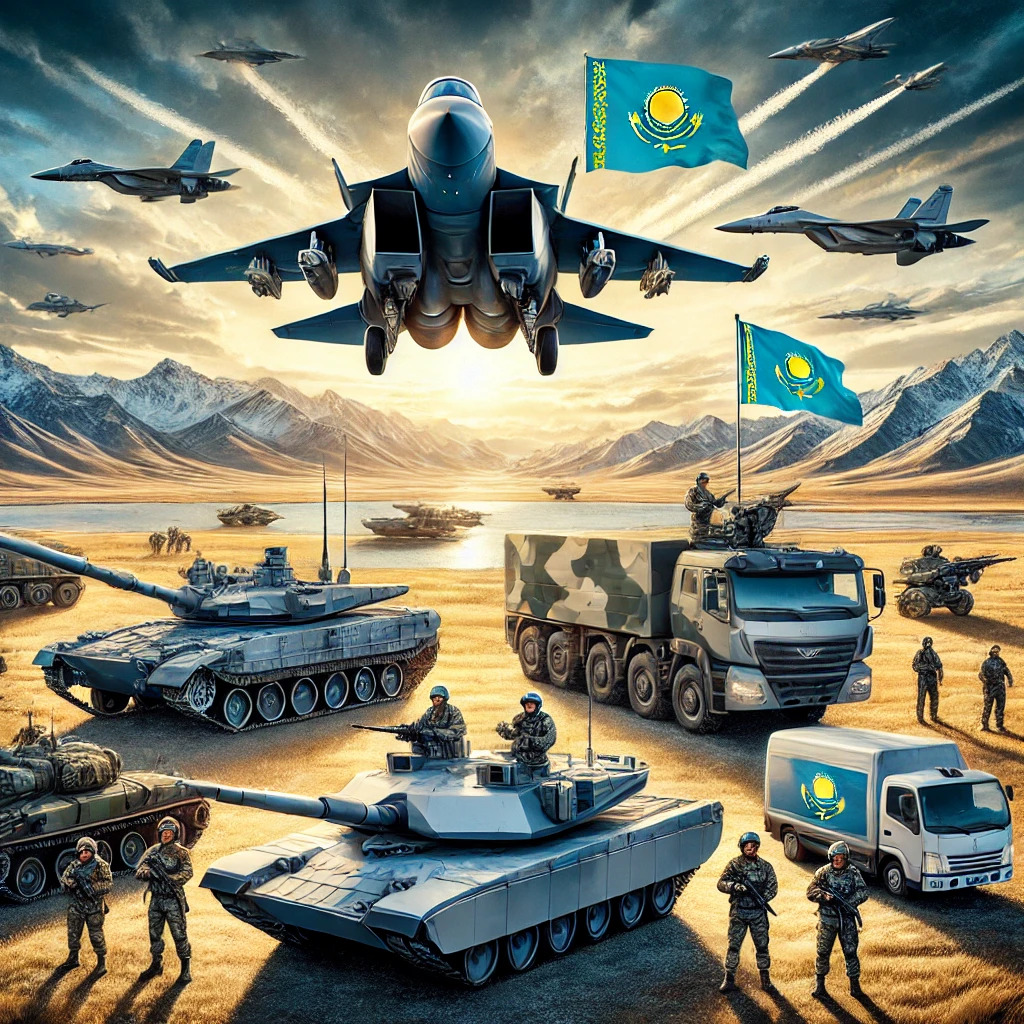
Military rankings love simple answers. How many tanks, aircraft and servicemembers does a country have — and what place does it occupy in the global table? But the wars of recent years have made this arithmetic increasingly unconvincing. Drones, secure communications, electronic warfare, decision-making speed, domestic industry, artificial intelligence and the ability to rapidly reorganize the armed forces are becoming no less important than the quantity of equipment.
A tank may be listed as operational — and be undergoing repairs. An aircraft may appear on an inventory list — but lack a modern weapons suite. An army may possess large quantities of artillery — but still fall behind an adversary in reconnaissance, drones and the speed of transmitting coordinates. And vice versa: a state with relatively compact armed forces can gain a serious advantage through better command and control, professional training, modern communications and a technologically advanced defense industry.
That is why assessing Kazakhstan’s armed forces in 2026 solely by the number of platforms is becoming increasingly difficult.
The Military Doctrine Already Assumes a Different Kind of War
Kazakhstan’s updated 2022 Military Doctrine already considers the expansion of hostilities into the space and information domains, the use of cyberattacks, hybrid methods, Special Operations Forces, robotic systems and precision weapons. It separately emphasizes increasing the speed of troop command and control through automated systems.
The doctrine provides for the development of Special Operations Forces, the strengthening of the radar field and air and missile defense, the maintenance of a naval grouping on the Caspian Sea, the development of the defense industry and the introduction of automated command-and-control systems for troops, weapons and resources. The armed forces are being modernized not only through procurement — the very model of use is changing.
Special Operations Forces: A Separate Capability Created in Four Years
Kazakhstan’s Special Operations Forces emerged as an independent structure in January 2022. Their missions include special operations in the interests of defense and military security, including countering illegal armed formations and participating in counterterrorism operations. In a relatively short period, a separate system of training, equipment and international cooperation began to form around the new command.
Kazakhstan’s Special Operations Forces participate in the Warrior Competition at Jordan’s King Abdullah II Special Operations Training Center — an international event that brought together units from approximately 40 countries in 2025. SOF personnel also participated in the multinational Anadolu-2025 exercises in Türkiye, training for operations in urban and mountainous terrain, freefall parachuting, UAV employment, evacuation and tactical medicine.
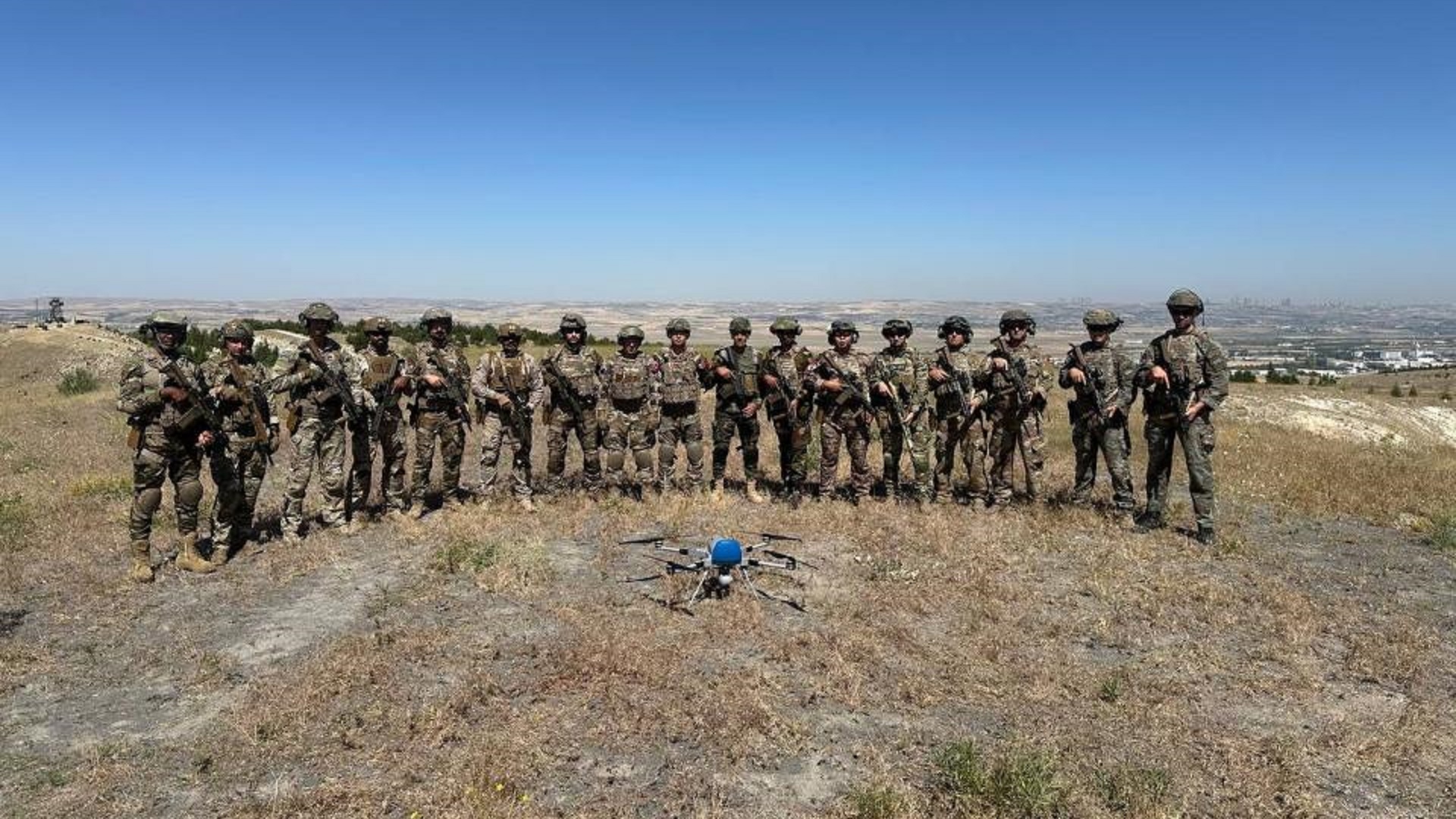
The overall quality of Kazakhstan’s special operations community is also worth noting. At the UAE SWAT Challenge 2026, Kazakhstan’s representatives took first and second place overall among 109 teams from 48 countries. The quality of such units is virtually impossible to express through troop numbers alone.
Drones: From Purchasing Platforms to Building an Ecosystem
Unmanned aerial systems units have existed in the Air Assault Forces for several years. But what is especially significant is that the troops are gradually moving from operating ready-made platforms toward their own technical cycle. Specialized workshops began operating in December 2025: they assemble, configure, test and repair UAVs before transferring them directly to military units. One such facility alone has reached a production rate of more than 100 drones per month.
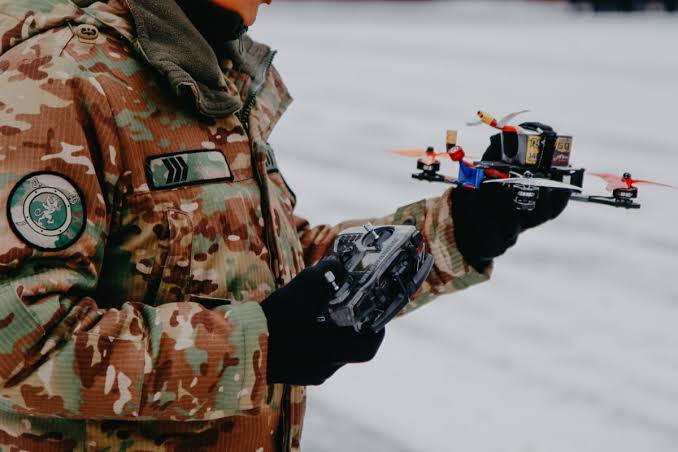
UAS units have already been used in major exercises for aerial reconnaissance, adjustment of aviation and artillery fire, strike operations and real-time unit control. Electronic intelligence units have also appeared in the Air Assault Forces, while UAV operators and electronic-warfare specialists are being trained at military training centers.
A chain is taking shape: operator — drone — reconnaissance — communications — fire-support asset — electronic warfare — repair and production. Such networks have become one of the defining features of modern armed conflicts.
SHAIQAS 2026: Technology Starts Reaching the Troops Directly
In 2026 the Ministry of Defense held the national military-engineering championship SHAIQAS for the first time. The project brought together developers of unmanned aerial systems, ground robotics specialists, cybersecurity experts, students, engineers, servicemembers and representatives of the defense industry.
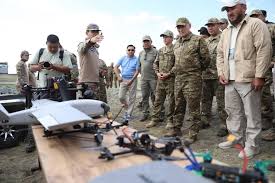
The winner was the R&D Center team of Kazakhstan Engineering. The Ministry of Defense stated that the most promising developments were not intended to remain demonstration prototypes: together with industrial partners, they would be tested and refined for serial production for the Armed Forces. This is a small episode against the background of the entire military, but it is significant as an indicator of direction.
Armored Vehicles: No Longer Just Repairing Soviet Legacy
Kazakhstan Paramount Engineering in Astana has a full production cycle for modern armored wheeled vehicles — from metalworking and the manufacture of armored capsules to final assembly and testing. Its product line includes the Arlan, Alan-2, Barys 4×4, 6×6 and 8×8, as well as the Terrex-Barys-A 8×8.
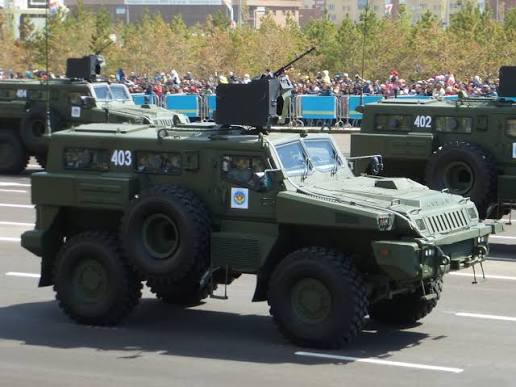
According to the government, the company’s capacity allows it to produce up to 500 vehicles annually. More than 400 units have already been produced, while the order book through 2028 includes another 224 vehicles. The importance of these figures lies not only in the quantity: Kazakhstan is developing its own engineering and manufacturing competence in the protected wheeled-vehicle segment.
At the same time, a substantial repair base is being maintained. Semey Engineering specializes in the overhaul and modernization of T-72 tanks, BMP-1/2 infantry fighting vehicles, BTR-60/70/80 armored personnel carriers, self-propelled artillery and other armored vehicles. Kazakhstan Aselsan Engineering works in communications, radar, electronic warfare, electro-optics, avionics and command-and-control systems, while the Zenit plant in Oral specializes in shipbuilding.
This industrial foundation is often lost in conventional rankings. They usually count how many pieces of equipment a state has today. It is much harder to assess something else — what the country will be able to repair, modernize or produce independently tomorrow.
A400M: Kazakhstan Gains a Capability It Did Not Have Before
In December 2024, Kazakhstan received its first Airbus A400M Atlas, becoming the first operator of this type in Central Asia. Two aircraft have been ordered in total, with delivery of the second scheduled for 2026. The A400M matters not so much as another item of aviation equipment, but as an entirely new capability.
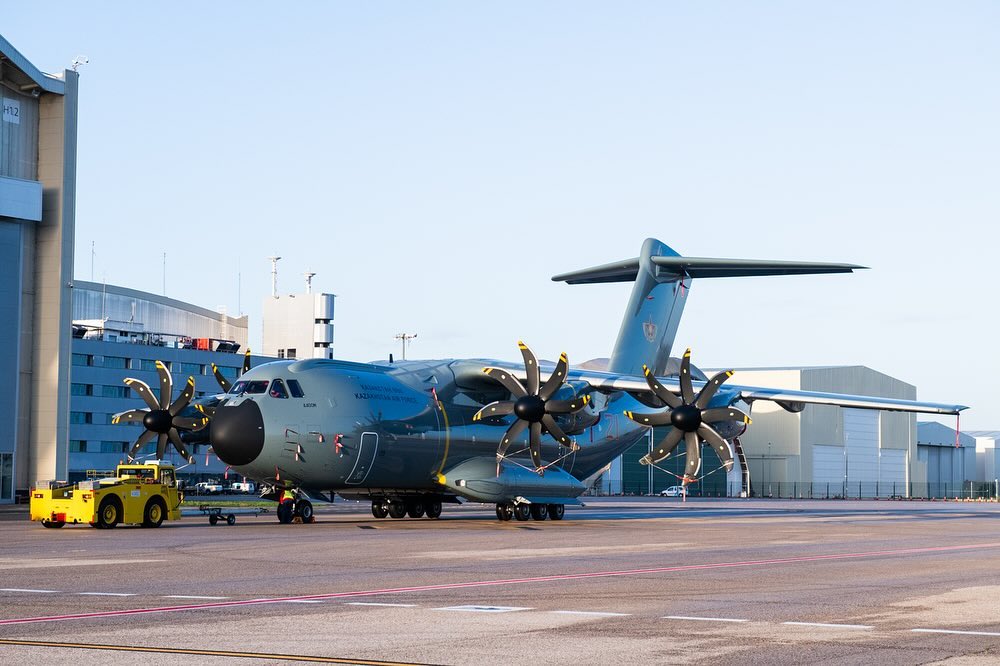
For Kazakhstan, with its vast territory, military mobility is particularly important. Interestingly, even Global Firepower — whose shortcomings are discussed below — places Kazakhstan considerably higher in military transport aviation than in its overall ranking: 31st among 145 countries.
The Army Is Beginning to Use Artificial Intelligence
In 2025, the Ministry of Defense created a special unit responsible for introducing artificial intelligence. Its stated tasks include analyzing large data sets, automating command and control, modeling operational scenarios and increasing decision-making speed.
Artificial intelligence cannot be placed in a column next to a tank. But a system that processes intelligence faster and helps a commander shorten the “detect — decide — engage” cycle may provide a more serious advantage than several dozen additional pieces of equipment. Retired Colonel and military expert Darkhan Daniyarov considers the speed of this cycle one of the key indicators of a modern army.
Space and the Maritime Component
The country has the national KazSat satellite communications system, including KazSat-2 and KazSat-3, as well as the Akkol and Kokterek ground control complexes. The Earth remote-sensing system includes KazEOSat-1 and KazEOSat-2, along with national ground complexes for control, reception and data processing. Overall, Kazakhstan’s aerospace sector has three satellite groupings: communications, remote sensing, and scientific and technological purposes.
Kazakhstan’s Armed Forces also operate on the Caspian Sea: the Navy ensures the security of Kazakhstan’s Caspian sector and protects ports and oil and gas infrastructure. A significant part of the fleet was built in Kazakhstan — the missile-artillery ships Kazakhstan, Oral, Saryarka and Mangystau were built at the Zenit plant in Oral. This produces a combination that is rare in Central Asia: ground forces, air and air-defense capabilities, Special Operations Forces, unmanned systems, national space infrastructure and a separate maritime component.
Another Indicator: Actual International Service
As of May 2026, 156 Kazakh servicemembers were serving in seven UN missions, including 139 as part of the national contingent on the Golan Heights. Since 2014, approximately 800 Kazakh servicemembers have participated in UN peacekeeping missions. The Golan mission became Kazakhstan’s first independent peacekeeping operation by a national contingent under the UN flag.
This is, of course, not combat experience in a major war. But it is real experience in prolonged overseas deployment: communications, logistics, command, patrolling, interaction with international structures and sustaining a unit far from national territory. That too is part of military potential.
How Do Global Rankings Measure All This?
There is no universally recognized international ranking capable of objectively naming the “first,” “second,” or “fiftieth” strongest army in the world. The most professional military-analytical institutions generally prefer not to make such conclusions.
The Military Balance 2026, published by the International Institute for Strategic Studies (IISS), covers the armed forces of more than 170 states: force organization, personnel, weapons, defense budgets, procurement and defense economics. But it does not offer a final “who is stronger” table. From the IISS perspective, it is more important to know what formations a state has, how they are equipped and which rearmament programs are being implemented. Kazakhstan is not “number 43” or “number 58” there — it is a specific set of military capabilities.
Janes Military Capabilities follows a similar philosophy: it holds information on more than 40,000 military units, over 30,000 military facilities and comprehensive weapons inventory data for more than 190 countries, including unmanned systems. Professional analysis asks different questions: not only how many tanks there are, but which units have them, how those units are organized, where they are deployed and what systems support them.
There Is Also a Ranking That Places Kazakhstan 43rd
Among alternative systems, the Military Power Rankings 2026 are of interest: Kazakhstan ranks 43rd in the world, and the authors explicitly describe the country as Central Asia’s most capable military actor. In the overall table, Kazakhstan ranks above Serbia, Finland, Azerbaijan, Jordan, Romania, the United Arab Emirates and Norway.
This, of course, is not absolute truth: MPR is an independent analytical project, not an international standard. But its methodology is interesting: for 2026 it uses 114 factors, including force readiness, doctrine, logistics, geography, industrial potential, strategic depth, technology and the ability to sustain combat operations. Changing the set of criteria alone moves Kazakhstan from the sixth decade of the global table into the beginning of the fifth.
The research of the Oxus Society for Central Asian Affairs is even more revealing: it studies the armed forces of the five Central Asian states directly and has built a database of more than 6,000 military and security infrastructure sites in the region. In a study published on 4 March 2026, the authors note that Kazakhstan already surpasses its main regional peer in several key military categories and forecast that the gap will continue to widen.
The Academy of Military Sciences Offers Its Own Approach
The President of the Academy of Military Sciences, retired Colonel Mukhtar Serikbayev, believes the assessment of armies must be supplemented with criteria that became decisive in the twenty-first century: unmanned systems, digitalization, space infrastructure, military science and the defense industry. In his 100-point assessment, Kazakhstan receives approximately 87 points, Uzbekistan 74.5, Turkmenistan 64, and Kyrgyzstan and Tajikistan approximately 39 each.
“Today, armies must be assessed not from the perspective of the last century, but on the basis of the real factors that affect the combat effectiveness of the armed forces,” the expert notes. It is important to understand that this is the Academy’s expert model, not a universally recognized international ranking.
Global Firepower and What It Barely Sees
The ranking most familiar to the general reader places Kazakhstan 58th among 145 countries in 2026, with a PowerIndex of 1.0433 — roughly within the top 40 percent of assessed states. But the internal indicators are more interesting: 19th in the world in multiple rocket launchers, 31st in military transport aviation, 32nd in self-propelled artillery, 33rd in attack helicopters, 35th in attack aircraft, 38th in armored vehicles, 39th in tanks and 41st in fighter aircraft. Even in the maritime segment, Kazakhstan ranks 17th in mine-warfare assets.
The problem with GFP is not that its data are useless, but that its ordinal position is turned into a final conclusion about combat capability. Drones are excluded from Airpower altogether: a country may produce thousands of FPV drones and reconnaissance UAVs, yet its air-power indicator will not change directly. It is also difficult to assess adequately actual electronic-warfare capabilities, secure communications, C4ISR, automated command and control, the cyber component, the quality of the officer corps, unit training, the integration of artificial intelligence and the defense industry’s actual production capacity.
There is another characteristic feature. For Kazakhstan’s aviation, GFP calculates equipment availability using the U.S. Air Force’s average readiness level of 75 percent, and for ground equipment it applies an 80-percent benchmark based on the U.S. Army. The values themselves are marked with an asterisk as estimates. The notional “readiness” of a tank or aircraft in the table is therefore a mathematical assumption, not an inspection of equipment at a specific air base or tank brigade.
“A Modern Army Is No Longer the Sum of Individual Platforms”
“Today, it is not enough to know how many tanks or aircraft an army has. We need to understand how many are actually ready, who operates them, what reconnaissance, UAVs, electronic warfare, communications and precision munitions are available, and how quickly information moves from the unit that detects a target to the weapon that engages it. A modern army is no longer the sum of individual platforms, but a system,” Darkhan Daniyarov notes.
The development of indigenous armored vehicles, the unmanned sector, Special Operations Forces, automated command-and-control systems, artificial intelligence, military transport aviation and the defense industry represents a change not so much in the quantity of weapons as in the country’s set of capabilities. Mukhtar Serikbayev holds a similar position: for him it is crucial that comparison not turn into a regional race for an attractive first place, and that the task be to create armed forces suited to the nature of twenty-first-century warfare.
A Strong Army Is the Ability to Change
43rd place in one alternative assessment system. A place in the global top 20 for multiple rocket launchers in GFP. Top-30 positions in military transport aviation and self-propelled artillery. First place in the Academy of Military Sciences’ expert model. Indigenous armored-vehicle production. More than 100 drones assembled each month at a single military facility. The A400M. National space infrastructure. A Caspian naval force. A separate Special Operations Forces Command. Artificial intelligence and automated command and control. An independent UN contingent.
Each of these indicators, taken separately, still does not answer the question of an army’s actual strength. Together, however, they show the direction: Kazakhstan is gradually moving away from a model of armed forces built primarily around maintaining the Soviet legacy and is forming a more mobile, technological and multi-component military system.
That is why the main question today is probably no longer what place Kazakhstan occupies in the next table. What matters far more is how quickly the state can turn its economy, industry, technologies, personnel training and weapons into real military capabilities. By this measure, Kazakhstan has indeed made one of the most notable leaps in Central Asia in recent years.